
Africa’s Digital Economy Is Expanding Faster than Its Privacy Protections

By DIA MICHELLE BUA, Programs Officer
18th May 2026
Africa’s digital economy is growing at a remarkable speed. Across the continent, millions of citizens now rely on mobile money platforms, fintech applications, digital lending services, e-commerce ecosystems, online betting platforms, e-government portals, and AI-powered digital services in their everyday lives. Yet while digital transformation accelerates, the systems designed to protect citizens’ personal data are struggling to keep pace.
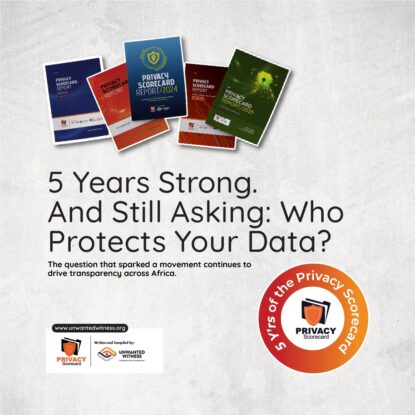
The newly released Privacy Scorecard Report 2025 by Unwanted Witness paints a sobering picture of Africa’s evolving digital governance landscape. The report, now in its fifth edition, assessed 286 organizations across nine African countries and eight major sectors, examining how companies and public institutions collect, process, store, and protect personal data.
The findings reveal a continent making gradual progress in data protection compliance, but still far from achieving mature, rights-respecting digital ecosystems.
The overall continental privacy compliance score improved from 40% in 2024 to 46% in 2025, indicating moderate gains in awareness and regulatory responsiveness. However, the score also confirms that privacy protection across Africa remains structurally weak and uneven.
At the heart of this contradiction lies a troubling reality: Africa’s digital economy is expanding faster than its privacy protections.
A Digital Boom Built on Data

From Lagos to Nairobi, Kigali to Accra, digital platforms are becoming central to commerce, banking, governance, and social life. Mobile money ecosystems continue to deepen financial inclusion. Digital lending applications are spreading rapidly among underserved populations. Governments are increasingly digitizing identity systems, immigration services, tax administration, and social services.
But these systems are powered by one increasingly valuable commodity: personal data.
Every mobile transaction, biometric verification, GPS location, health record, betting profile, digital loan request, and online purchase contributes to an expanding data economy that often operates with limited accountability and inconsistent oversight.
According to the report, concerns persist regarding unauthorised surveillance, weak enforcement mechanisms, excessive collection of personal data, opaque third-party data-sharing practices, inadequate consent frameworks, and poor breach response mechanisms, which continue to expose data subjects to significant privacy and security risks.
Despite the introduction of comprehensive data protection laws in Nigeria, Ghana, Botswana, Rwanda, Tanzania, Mauritius, Zimbabwe, Kenya, and Uganda, implementation remains inconsistent, and enforcement institutions continue to face capacity limitations.
The result is a dangerous imbalance: digital systems are scaling faster than the institutions responsible for safeguarding citizens’ rights.
Kenya Leads, Zimbabwe Trails
Among the nine countries assessed, Kenya emerged as the strongest overall performer with a privacy compliance score of 46%, followed closely by Nigeria at 44%, Uganda at 43%, and Mauritius at 40%. Ghana and Botswana both recorded 36%, while Rwanda and Tanzania scored 33%. Zimbabwe ranked lowest overall at 28%.
These rankings reveal significant disparities in institutional maturity, regulatory enforcement, and corporate accountability across the continent.
Kenya’s leadership reflects years of investment in regulatory frameworks, digital governance structures, and private-sector compliance mechanisms. Nigeria’s strong debut performance demonstrates the growing influence of its data protection ecosystem and regulatory reforms.
Meanwhile, Zimbabwe’s low ranking highlights the persistent gaps facing many African countries, including weak enforcement systems, low organizational compliance maturity, and limited institutional capacity.
The report notes that newer entrants such as Ghana and Botswana are establishing important baselines for future progress, while countries like Rwanda and Tanzania are showing early signs of institutional growth.
Yet even among the leading countries, no jurisdiction demonstrated mature or comprehensive privacy governance.
Banks Lead While Health Systems Lag Behind
One of the clearest patterns emerging from the report is the uneven maturity across sectors.
The Banking and Finance sector emerged as the continent’s strongest performer with an overall score of 52%, improving from 42% in 2024. Telecommunications followed at 46%, while Insurance scored 44%.
This performance reflects growing regulatory pressure within financial systems, stronger cybersecurity investments, and the increasing importance of consumer trust in digital finance ecosystems.
Banks are increasingly recognizing that privacy protection is no longer simply a compliance issue, it is a core business and reputational imperative.
However, the report simultaneously exposes alarming weaknesses in sectors handling some of the most sensitive categories of personal data.
The Health sector recorded the lowest overall score at just 22%.
This finding is particularly concerning given the highly sensitive nature of medical records, biometric information, patient histories, and diagnostic data processed by hospitals and healthcare providers.
Several hospitals scored below 15%, revealing weak consent mechanisms, inadequate privacy governance, limited transparency, and poor data security practices.
The report warns that many health institutions remain significantly underprepared to manage the growing risks associated with digital health systems, electronic medical records, and interconnected healthcare technologies.
Government agencies also performed poorly, scoring only 25%, exposing broader concerns about state accountability and citizen data protection.
Fintech Growth without Privacy Maturity
Perhaps the most revealing trend emerging from the report is the rapid growth of fintech and digital lending ecosystems without corresponding growth in privacy governance.
Digital lending platforms scored just 37%, reflecting uneven compliance across one of Africa’s fastest-growing digital sectors.
While a few firms demonstrated stronger data governance practices, many platforms continue to rely on aggressive data harvesting, intrusive permissions, opaque profiling systems, and weak consent mechanisms, raising serious concerns about algorithmic accountability, financial profiling, behavioral surveillance, and the growing exploitation of vulnerable consumers.
As fintech ecosystems expand across Africa, financial data increasingly becomes both an economic asset and a mechanism of power.
The Mobile App Surveillance Problem
The report also examined the 20 most widely used mobile applications across the assessed countries and found persistent and systemic privacy risks.
Fourteen apps were classified as potentially dangerous due to their excessive use of trackers and intrusive permission requests, highlighting growing concerns over opaque data collection practices within mobile ecosystems. The assessment further revealed that tracking infrastructures remain heavily concentrated around major global technology companies, particularly Google and Meta, which together accounted for more than two-thirds of all observed trackers.
Many of the assessed applications continued to collect highly sensitive user information, including location data, device identifiers, camera and microphone access, background activity permissions, and behavioral data, often without meaningful user awareness, informed understanding, or genuine consent.
The report concludes that Africa’s mobile app ecosystem remains structurally weak from a privacy perspective, leaving millions vulnerable to profiling, surveillance, and data misuse.
Laws Alone Are Not Enough
One of the most important conclusions emerging from the Privacy Scorecard Report 2025 is that legal reform alone cannot guarantee privacy protection.
Africa has made undeniable legislative progress, with countries across the continent increasingly adopting comprehensive data protection frameworks aligned with global standards such as the GDPR and the Malabo Convention. However, the report demonstrates that laws without effective enforcement remain largely symbolic.
Despite the existence of these legal frameworks, many countries continue to face significant challenges, including limited institutional capacity, weak regulatory funding, inconsistent compliance cultures, inadequate audits, and low levels of public awareness, all of which continue to undermine meaningful implementation and the effective protection of data subjects’ rights.
Many organizations still treat privacy compliance as reactive rather than embedded into governance and operational systems.
No sector exceeded 60% overall maturity.
That alone should concern policymakers, regulators, investors, and citizens alike.
The Future of Africa’s Digital Economy Depends on Trust

Africa’s digital transformation is no longer a future conversation, it is happening now.
Africa’s digital economy is projected to generate enormous economic value over the coming decade, fueled by fintech innovation, artificial intelligence systems, cross-border digital trade, smart infrastructure, and expanding internet access. However, sustainable digital growth cannot exist without public trust. Citizens must have confidence that their personal data will not be abused, that their financial information will remain secure, that their health records will be kept confidential, and that both governments and corporations will act responsibly, transparently, and accountably in the digital ecosystem.
The Privacy Scorecard Report 2025 ultimately serves as both a warning and an opportunity.
A warning that Africa risks building a digitally connected society without adequate safeguards for rights and dignity.
And an opportunity for governments, regulators, businesses, civil society, and technology providers to strengthen accountability before today’s vulnerabilities become tomorrow’s crises.
Because in the emerging digital economy, data is no longer merely information.
It is power.
And the question facing Africa is no longer whether digital transformation will happen, but whether privacy protections will evolve quickly enough to protect the people driving it.